
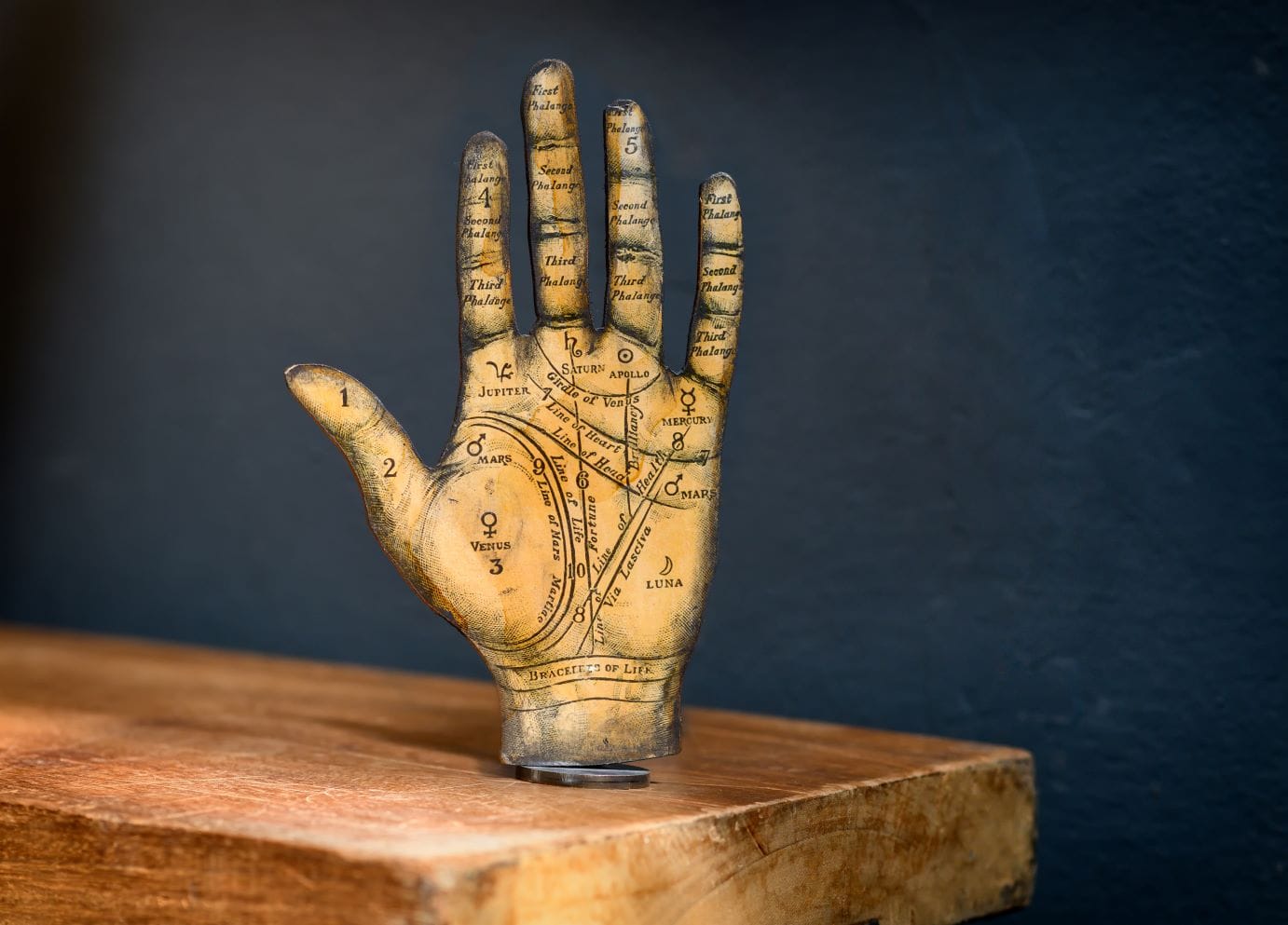
Palmistry — A Map Written in the Living Hand
Palmistry (also called chiromancy) is the art of reading the hand as a living portrait of a person’s energy, temperament, and life patterns. Your palm is not a fixed “fate script.” It’s closer to a weather map: it shows what is strong, what is sensitive, what is changing — and where your choices carry the most power.
A palm reading can feel quietly uncanny, not because it “predicts everything,” but because it reveals themes you already sense beneath the surface: how you love, how you work, how you recover, how you grow, and what you’re here to learn.
Palmistry + Astrology — A Practical Analogy
Diagram: Palmistry with Astrological Analogies
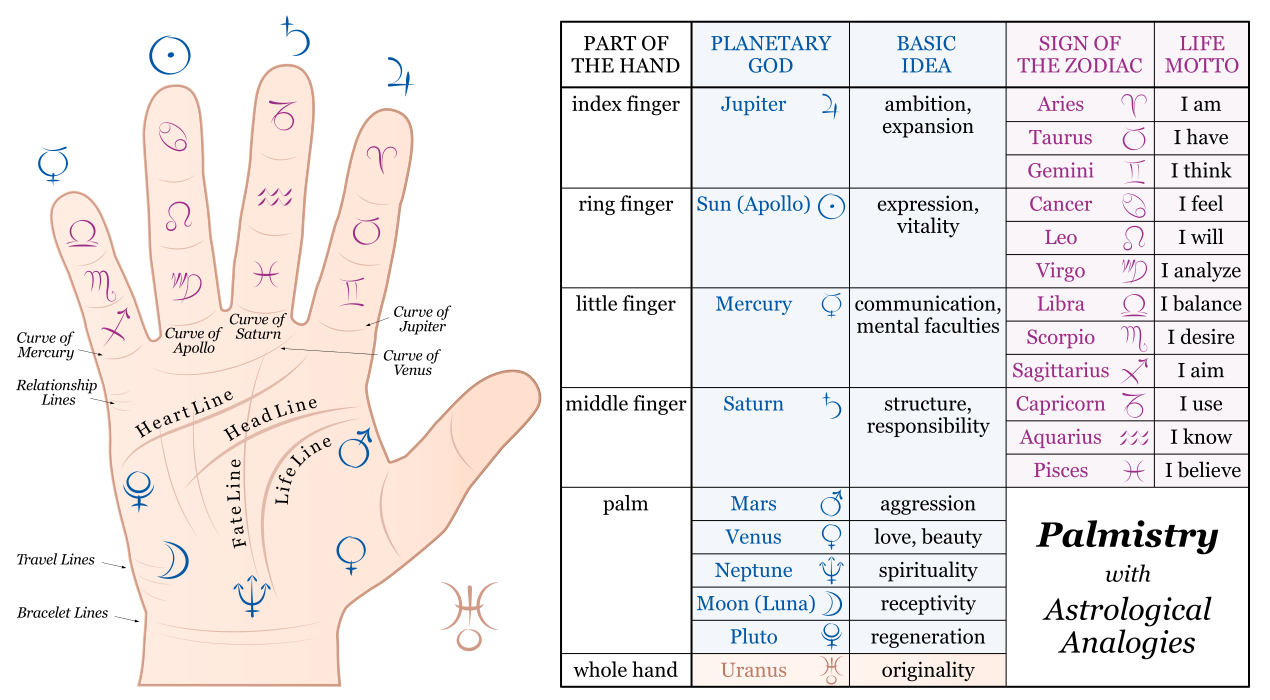
- Mounts = planets in the body: where energy gathers and expresses itself.
- Lines = life narratives: how those energies move over time (steady, intense, shifting, or split by choice).
- Hand type = element: your baseline approach (earth/air/fire/water) coloring everything else.
Where Palmistry Comes From
Palmistry has roots in multiple traditions across Asia, the Middle East, and Europe, evolving through centuries of observation and symbolism. Over time it became a practical craft: reading the hand’s structure and markings to describe personality patterns, emotional tendencies, and life cycles.
A Living Art (Not a Static Chart)
Hands change. Lines can deepen, soften, split, or rejoin. That’s why palmistry is often read as a story in motion: what you were born with, what you’ve built, and what is emerging now.
More Than Lines
A strong reading includes the whole hand: finger shapes, palm type, mounts, skin texture, flexibility, and the “tone” of the hand — the subtle clues that make the symbols feel precise.
Palmistry 101 — The Three Layers of a Reading
- Hand Type (Earth / Air / Fire / Water) — the “elemental signature” of how you move through life: practical, mental, driven, or intuitive/emotional.
- The Mounts — the padded areas of the palm (Venus, Jupiter, Saturn, Apollo, Mercury, Moon, Mars): they show what drives you, what you crave, and where your power gathers.
- The Major Lines — the classic trio: Heart (connection and emotional style), Head (mind and decision-making), Life (vitality and resilience) — plus the “secondary” lines that reveal vocation, fate patterns, and timing.
The Major Lines — What They Really Say
Heart Line
How you bond, how you express affection, what you need emotionally, and how you protect your heart. It speaks to your relational “language.”
Head Line
How you think, learn, and decide. It shows your mental rhythm: logic vs. intuition, focus vs. flexibility, and how you process pressure.
Life Line
Vitality, stamina, recovery, and the shape of your life experience — not “how long you’ll live.” It often reflects how you regenerate after change.
Fate / Career Line
Direction, calling, and the pull of purpose. It can show external influences, turning points, and how your path stabilizes over time.
How to Look at Your Own Hand (A Simple Ritual)
- 1. Start with your dominant hand (how you act now) and then compare the non-dominant hand (your deeper wiring).
- 2. Notice the overall hand: shape, fingers, flexibility, and texture — the “first impression” matters.
- 3. Read the major lines as a story: emotion (Heart) → mind (Head) → vitality (Life) → direction (Fate).
- 4. Ask one clean question: “What is emerging in my life right now?”
What You’ll Learn in Palmistry 101
- How to identify your hand type and what it reveals about your nature.
- How to read the major lines with nuance (without fear-based myths).
- How the mounts show desire, drive, and hidden strengths.
- How to spot turning points and “chapters” without turning the reading into fate.
- How to create readings that feel grounded, accurate, and empowering.